Outset
A planner that decides what you're doing this Saturday, works out the whole of it — where, when to leave, what to wear, what it'll cost, where to eat, what to do if it rains — and puts it in your calendar on Wednesday. You read one screen and get in the car.
99 places · within an hour of home · never the same one twice in a year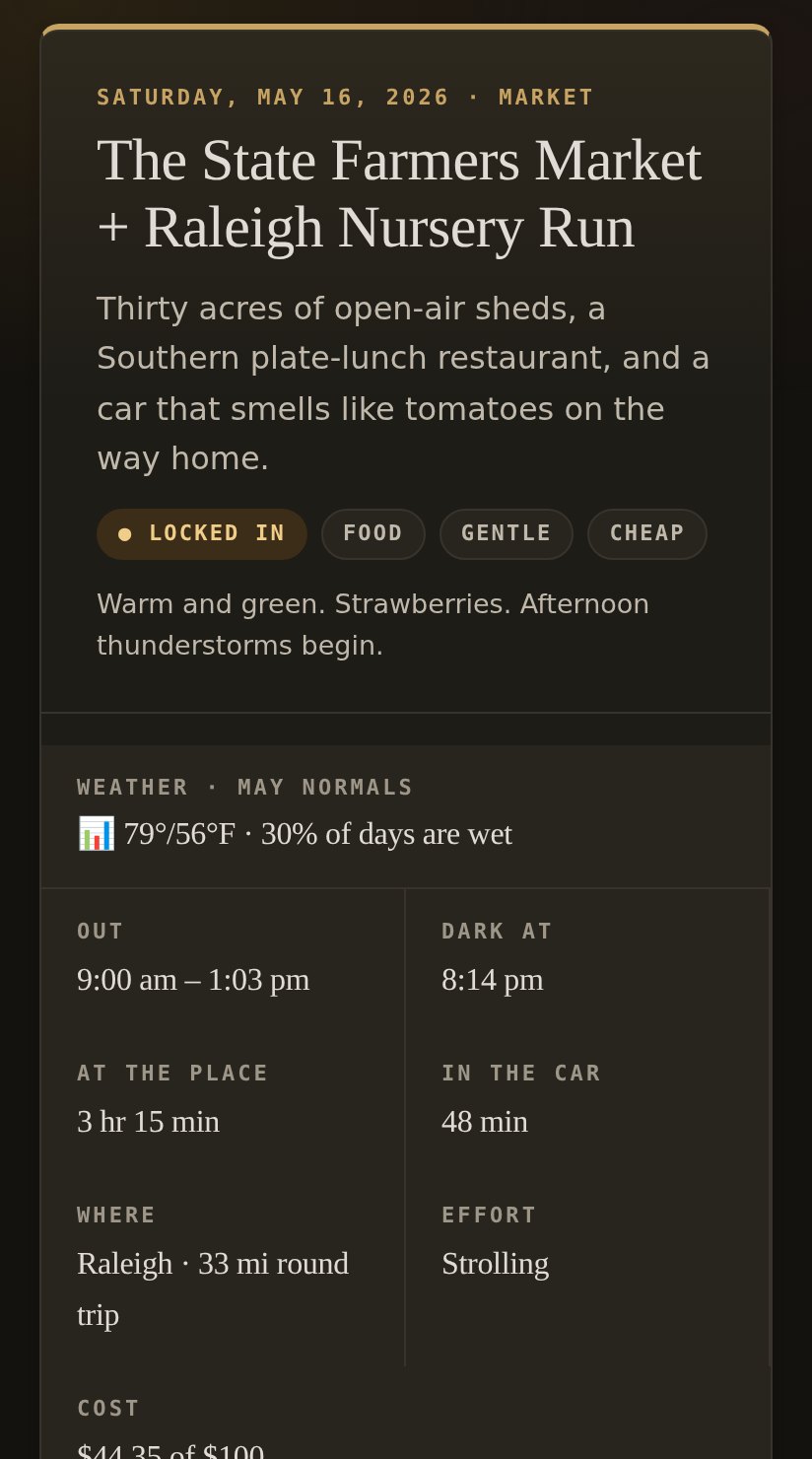
The idea
You don't plan the Saturday. You just have it.
A free Saturday is easy to waste. You spend the morning deciding, and by the time you've picked somewhere half of it is gone — or you don't decide at all and end up somewhere you've already been four times this year.
Outset does the deciding midweek and then does everything you'd otherwise be looking up on the morning. It keeps a catalogue of ninety-nine places within reach — trails, museums, small towns, a quarry you can swim in, a drive-in cinema — each one written up properly, and every Wednesday it picks the one that suits this particular Saturday and builds the day around it.
What arrives is not a suggestion. It is a plan with a departure time in it: where you're going, when to leave, what to wear, what it will cost, what to do first when you get there, where to eat, and a second day fully worked out in case of rain. The shape is the same every week, so a Saturday is always familiar even though where you're going never is.
It never asks you anything. No preferences to set, no three options to choose between, no empty box waiting for you to have a good idea. That question is the hard part, and an app that asks it every week is one you stop opening. Everything here is decided from the date, the forecast and where you've already been.
How a week goes
Four moments, three of which you sleep through
You are involved in exactly one of these, on the way home, and even that is optional.
- 1
Wednesday. It picks the Saturday and locks it. Locked means settled: from here the place will not change, whatever the weather does. The whole day is worked out, written into your calendar, and — if the Sunday course needs you to own something — that shopping list arrives now, with four days to do something about it.
- 2
Friday evening. It reads the forecast again and compares it to Wednesday's. Most weeks it says nothing at all, which is the point. When the weather has genuinely turned it updates the calendar event — and only tells you if the day has to change.
- 3
Saturday. The event is already on your phone, because you subscribed to the calendar once and it has kept itself up to date ever since. Departure time, what to wear and what to do first are in the first few lines, since that is all an agenda view will show you. Tap the address and your phone starts driving.
- 4
Afterwards. One tap says whether you went, took the backup, or didn't get to it. Say nothing and it assumes you went, because the planner never asks and silence is the normal state.
The Saturday
One screen, and nothing left to work out
The top of the card is what kind of day this is. Locked in means it's settled; the rest — food, gentle, cheap — is the shape of it, so you know at a glance whether Saturday is a hike or a long lunch. Under that, a sentence about what the place actually is, and a line about what the weather will be doing while you're there.
Then the facts, which are the part you look things up in. Six of them, and two of those are chosen to be read against each other: at the place and in the car. Three hours fifteen there against forty-eight minutes driving is a good Saturday. The same three hours against three hours of driving is a different proposition, and putting the two numbers side by side is the whole of how you're told which one this is.
Where the times come from
The leave time isn't nine o'clock because nine o'clock is when people leave. It's worked back from when the sun sets, how long the day takes, how far the drive is, and what time the doors actually unlock — a museum that opens at ten does not get a 9:20 arrival. In December the same trip starts earlier, because there's less daylight to spend.
Cost is the real total: tickets, lunch, parking, and the electricity for the drive, billed by the mile. It's shown against the ceiling rather than on its own, because $44.35 of $100 answers a question that $44.35 doesn't.
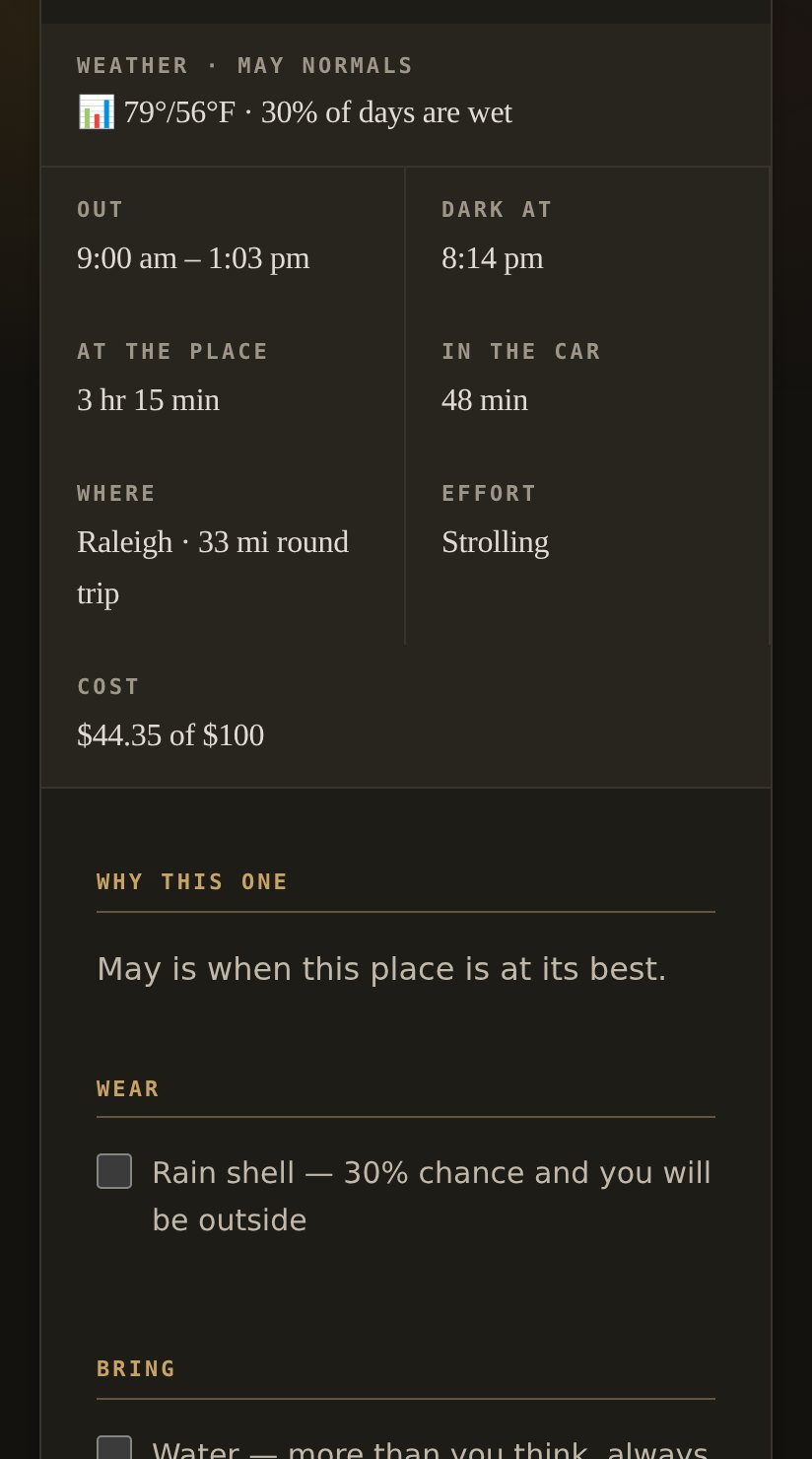
Six facts. The two durations sit next to each other so the comparison is made without anyone drawing it.
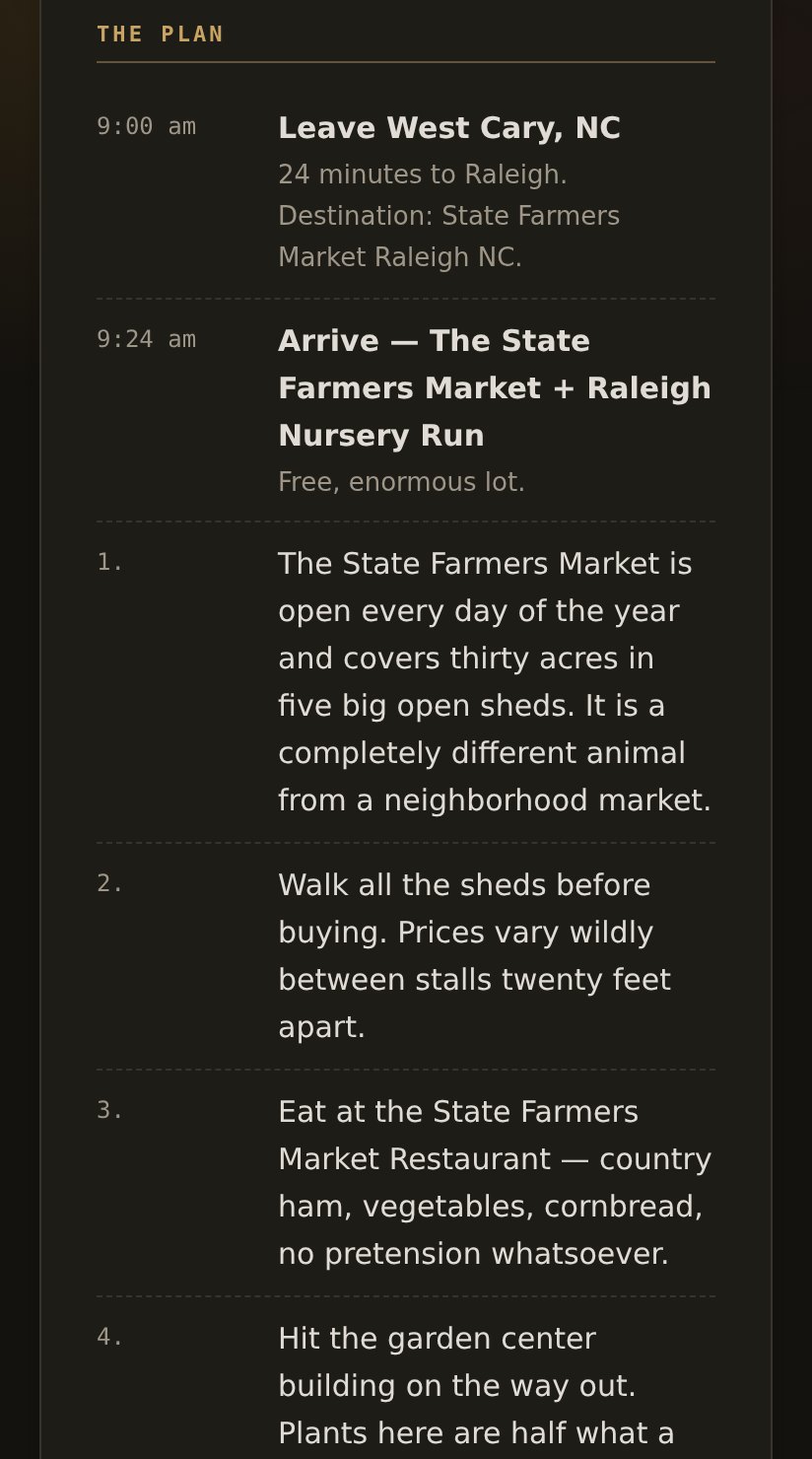
Clocks on the anchors, numbers on everything else.
The day itself, in order
Leave, arrive, eat, home — those four have real times on them, because a real decision sits behind each one. Everything in between is numbered rather than timed: walk all the sheds before you buy anything, prices vary wildly between them is advice about what to do first, not an appointment at 11:27.
The write-ups are the part that takes the longest to produce and does the most work. Each place gets what it actually is, what's worth doing when you get there, whether it's any good on your own, and the things you'd only know the second time — which door to use, where the free parking is, what to skip.
What to bring, and what it'll cost
Getting ready is three jobs rather than one list, and they are kept apart because they happen at different times.
- Wear. What you have on when you shut the front door — the only part you cannot fix from the car park.
- Bring. What goes in the bag.
- Before you go. Errands with a lead time: draw cash, download the map, check the hours on a place whose hours the catalogue has not verified.
All of it comes from this particular Saturday. A rain shell because there's a 30% chance and you'll be outside; cash because the sellers at this market don't take cards. On a Saturday that's indoors and dry, neither line appears.
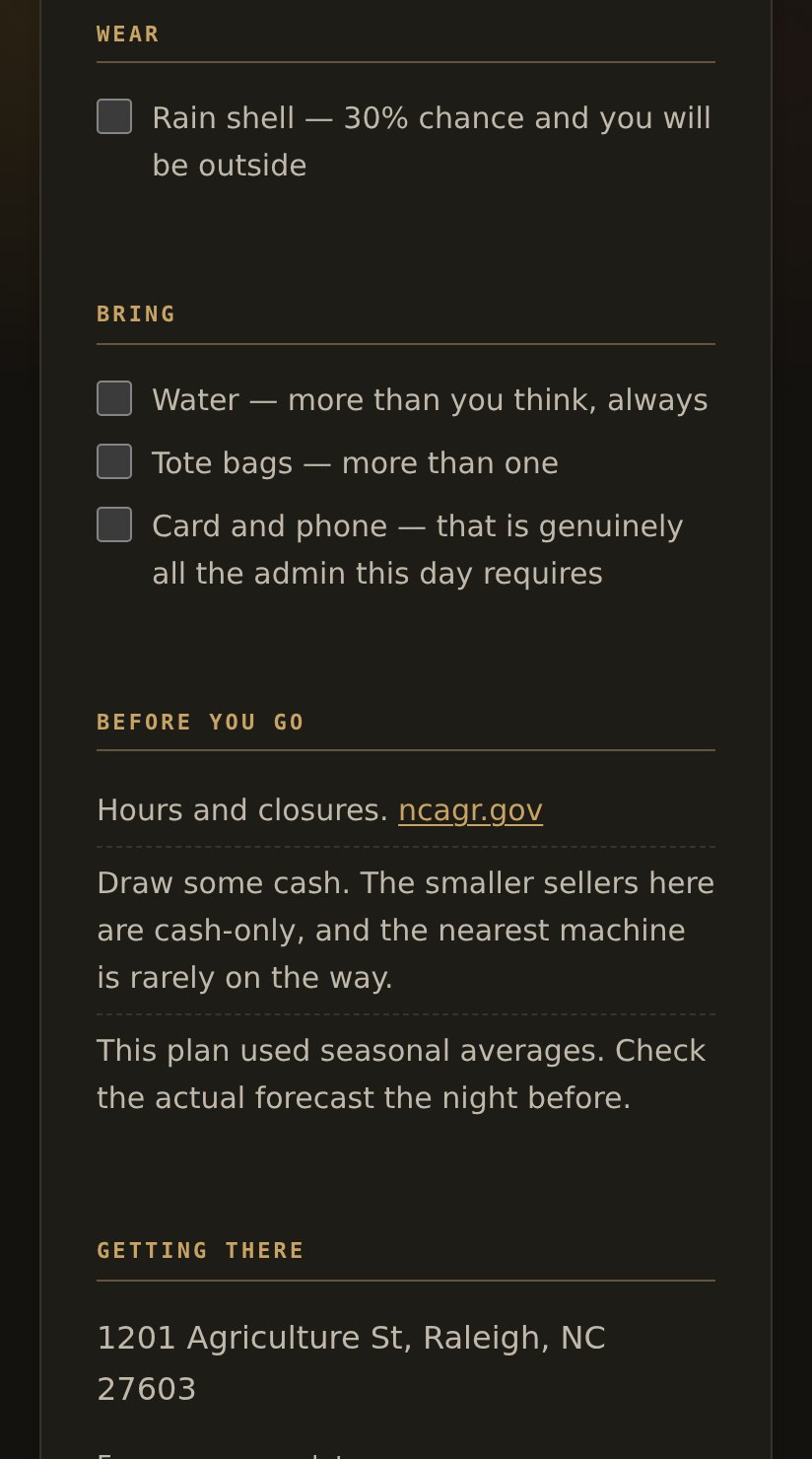
Wear, bring, and the errands that need doing first.
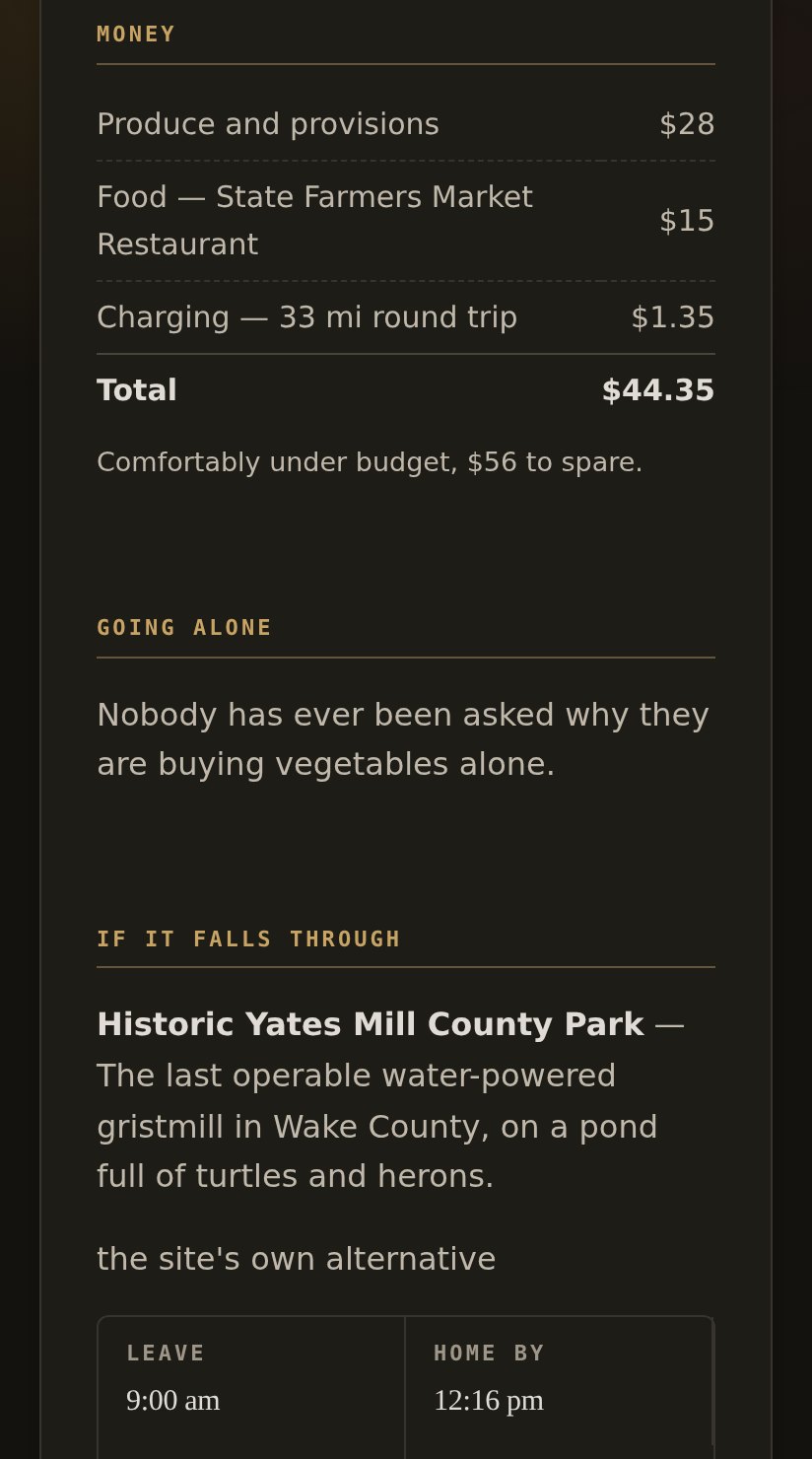
Every line, including the electricity. Never the same meal twice.
If it rains
There is always a second day, and it is a real one
Every Saturday comes with a backup, and the backup is not a name to go and look up. It carries its own leave time, its own budget, its own parking and its own directions, because the moment it exists for is a wet Saturday morning in the driveway — and "here is somewhere else, go plan it" is the one thing this is built never to do.
It's usually somewhere with a roof and usually closer. Historic Yates Mill instead of an open-air market: twenty-three minutes, home by quarter past twelve, seventeen dollars.
It's chosen on Wednesday and stored alongside the Saturday, rather than worked out on the morning you need it. The backup is picked against the same forecast as the main plan, and by Saturday that forecast has moved — so deciding it late would quietly hand you a different place than the one the week was built around.
Weather you can dress for is not a reason to cancel
Friday's re-check is deliberately reluctant. A 70% chance of rain on a walk is a shell, not a different Saturday — half of what makes a day worth telling anyone about is that it didn't go smoothly. Only two things earn a swap, and neither is a matter of grit.
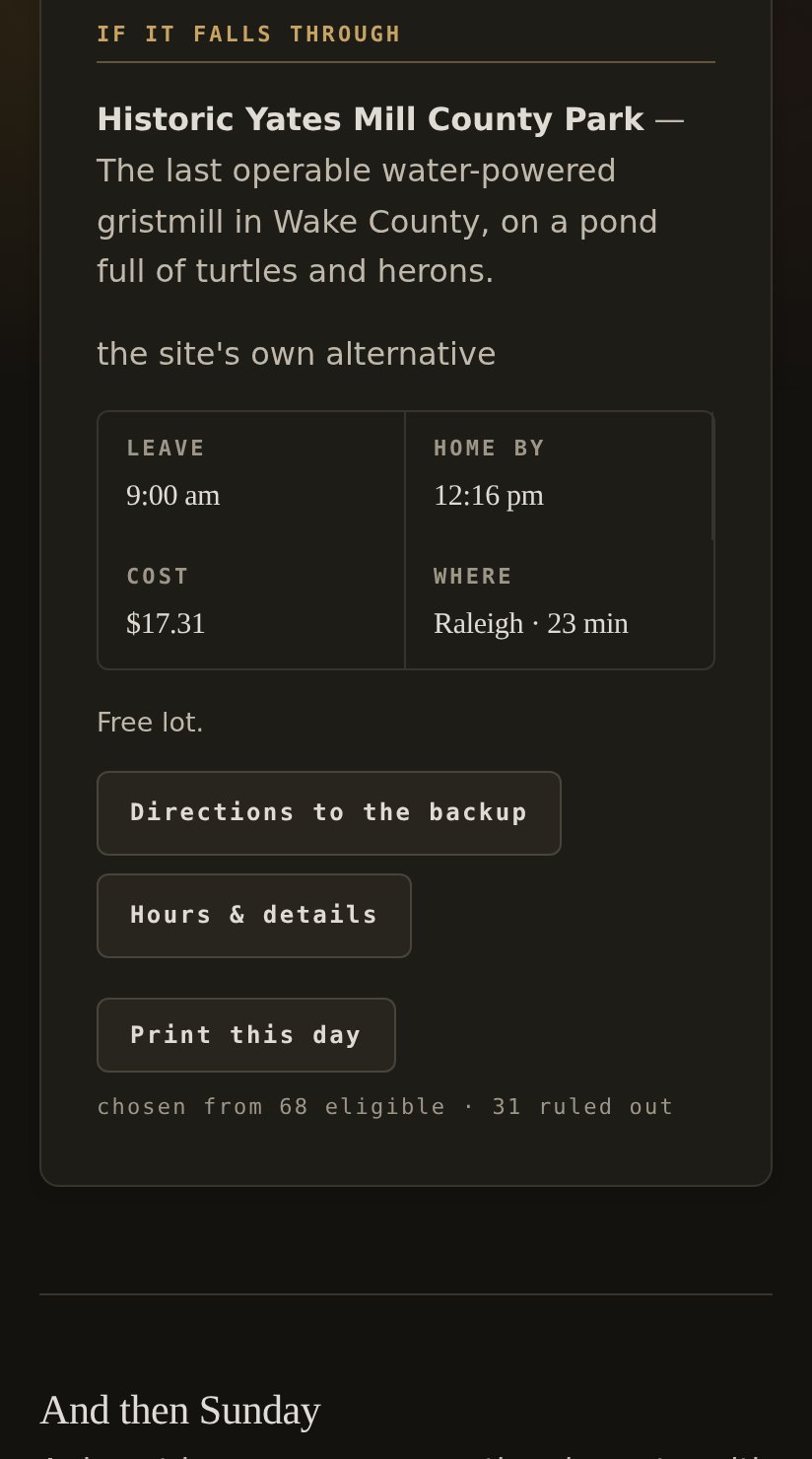
A whole second day, with its own everything. Note the line at the bottom: 68 places were eligible this week and 31 were ruled out.
| Verdict | When | What happens |
|---|---|---|
| Nothing | The forecast wobbled but you'd wear the same thing. | Silence. No message, no update. A job that speaks up weekly gets muted, and is then worth nothing on the week it mattered. |
| Dress | Same day, different clothes. | The calendar event is rewritten with the new packing list. Still no message — "it's going to rain" is not news. |
| Swap | Unsafe, or the thing you came for is off. | Take the backup. Lightning on open water, cloud on a night under the stars, ground too wet to walk without damaging the trail. |
| Stop | Same as swap, but there's nowhere to swap to. | It says so plainly rather than sending you somewhere it hasn't planned. |
The details
It thinks about the things you'd forget
Most of the work isn't picking somewhere nice. It's the dozen small facts that turn a nice idea into a day that actually works — the ones you'd only discover by getting them wrong once.
When it gets dark
Leave times are worked back from sunset, so the same trip starts earlier in December than in June, and you are home before you need a torch.
Whether the door is open
Not just whether the place is open that day but what time it unlocks, which is a different fact and the one that ruins a morning. Several of these museums open at ten.
Thursday's rain
Piedmont clay stays wet for days. A trail can be a mud bath under a perfectly blue Saturday sky, so the forecast it reads covers the two days in front of the Saturday as well.
The time of year
Waterfalls in spring, leaves in October, the swimming quarry in August, the winter eagle roost in December. Not the other way round.
The moon
A night under the stars on a full moon is a wasted drive, so above a certain brightness it simply isn't offered. Unlike the weather, where the moon will be is already known four months out.
Heat
A long day in the open won't get scheduled into a dangerous heat index. The same heat on a stroll is a slower stroll and more water, and it's treated differently.
There are three things to do with a fact nobody has checked: guess it, drop it, or hand it over. The first two both end with you finding out in the car. So an unverified opening time becomes a line in Before you go that costs you thirty seconds — and can be retired permanently by writing the answer down.
Variety
Never the same place twice
Anywhere you've been is off the list for a year. That one rule is what makes the whole thing worth subscribing to, and it's the rule a person keeping a list by hand always breaks first.
Underneath it are the softer ones. It alternates hard days with easy ones, so two long walks never land back to back. It moves you around the map rather than doing everything east of town in a month. It rations the day trips to one every six weeks or so, because a two-hour drive is a different kind of Saturday and three in a row stops feeling like a treat. And it leans on the season: what's good in April is not what's good in November.
Sixteen weeks are planned at any moment, and only the coming one is settled. The other fifteen are marked provisional and re-derived every Wednesday, because a real turn in the weather doesn't move one Saturday — it cascades, and renames the whole horizon at once.
places, each written up in full
kinds of day, from a gallery to a quarry swim
weeks planned ahead at any moment
the average Saturday, against a $100 ceiling

Ten weeks of Saturdays. A market, a mural walk, two small towns, a climbing wall, a drive-in, a swim, a garden, a gallery, a junk shop and a hemlock forest — and nothing repeated.
Sundays
And something to learn on the other day
Sundays are mostly spent at home, so there's a second, smaller planner for those. Not a day out — a day of study. One question, laid out in parts, with real sources, exercises to work through, and answers to check yourself against.
There are twenty-nine of them so far: what fungus is actually doing to a fallen log, how a phone knows where it is, how to look at a painting, why the tap water tastes like that. Each one is written and checked ahead of time and shipped with the app, so a Sunday course arrives whole rather than being assembled while you read it. What gets decided each week is which one suits this Sunday — against the season, the weather, and what Saturday turned out to be. A day at the creek on Saturday makes the water course more likely on Sunday.
A course is never offered twice
The sharpest difference between the two halves of the weekend. A place is worth going back to once enough time has passed; a lesson you've already read is not a day. So a Saturday gets a year's block and a Sunday gets a permanent one — which means running out is arithmetic rather than a fault, and the planner says how many Sundays are left before it happens.
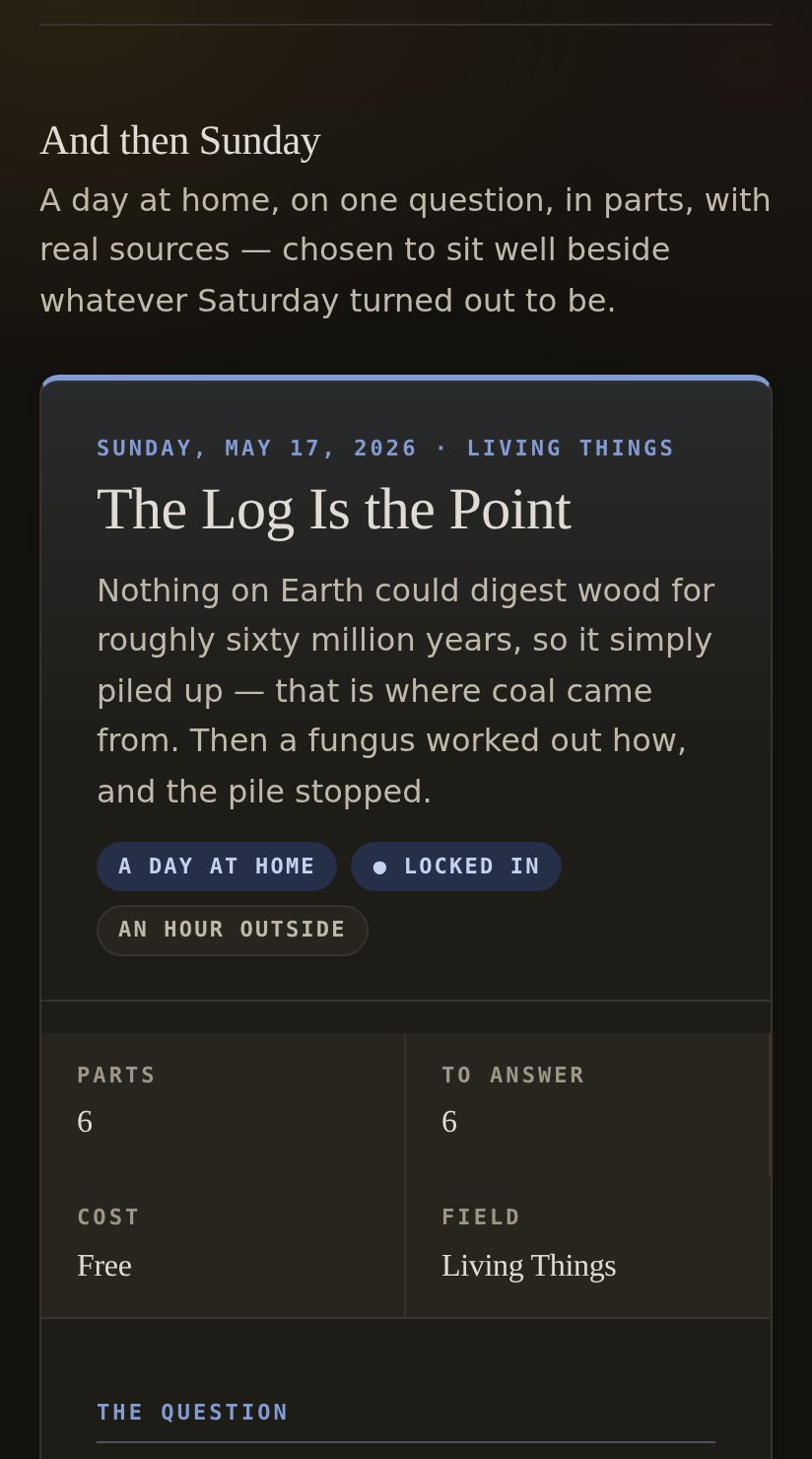
Slate for Sunday, ochre for Saturday. Six parts and six things to answer — no running time, because nobody measured one.
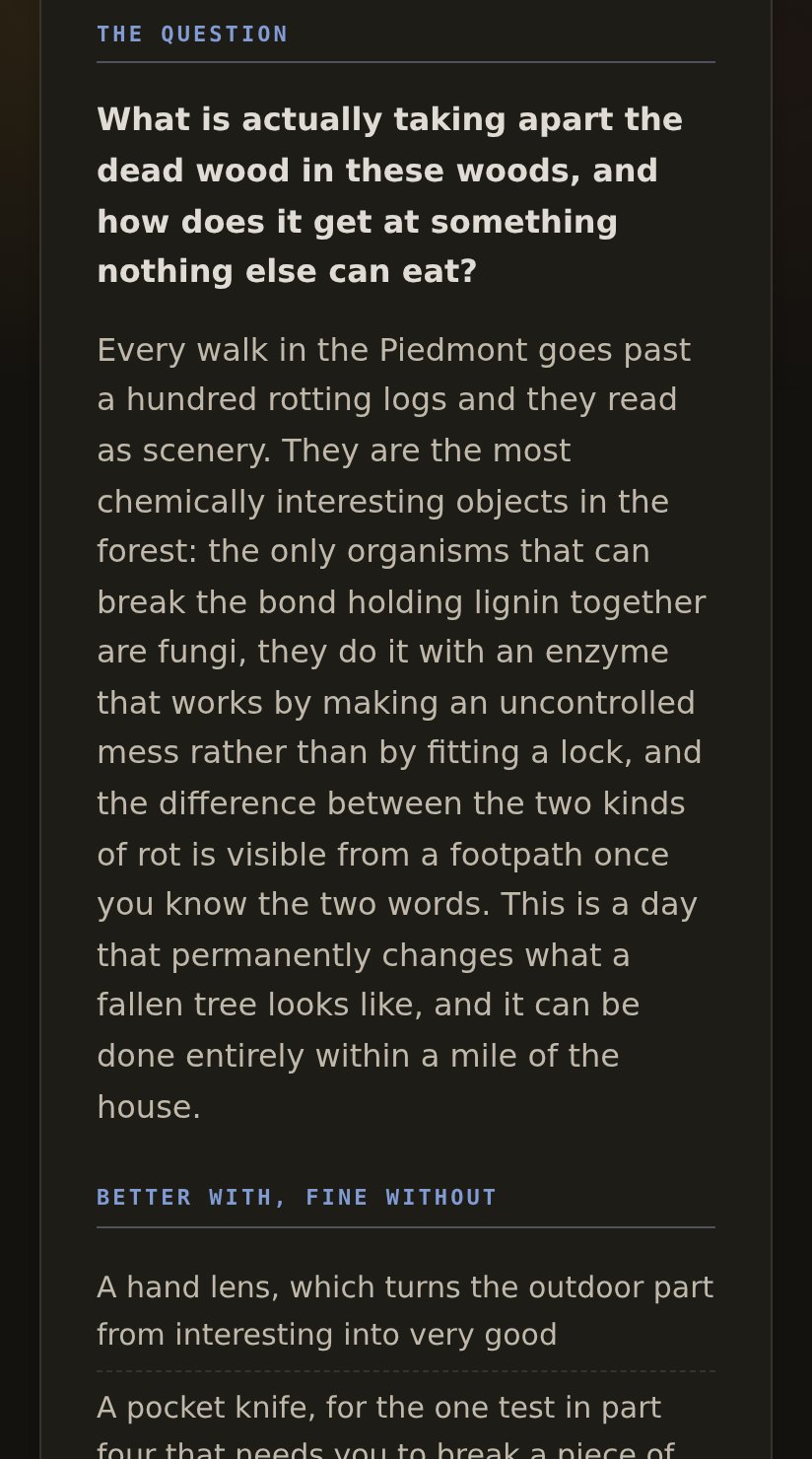
The lesson opens on its question, and the day is spent answering it.
A course teaches; a reading list assigns
The teaching is written out in full — paragraphs, figures drawn in plain characters so they render anywhere, worked examples, and questions whose answers are folded underneath rather than left for you to go and find. A link is for going further, never a way of avoiding writing the sentence.
There is no reading list, and nothing that sends you off to a page to find out what the day was supposed to tell you. If a course wants you to know something, it says it.
Each one ends with something specific you can now do, stated plainly enough that failing it is unambiguous. And a later Sunday will hand you a prompt to paste into a chat with an AI, made from an older lesson's questions, because checking whether something stuck is a job this thing genuinely cannot do itself.
Afterwards
It keeps count, and it keeps the days
Saturdays, miles, what they cost, how many kinds of day you've had. Every past Saturday stays fully readable — the plan, the itinerary, the money, the tips — so a place you liked in March can be reopened in November.
Reporting back is one tap: went, took the backup, or didn't get to it, with room for a note afterwards if you want one. Nothing is required. Silence is read as having gone, because the planner never asks and reading silence as "didn't go" would delete almost the whole record. Only saying so is knowledge — and a Saturday you say you skipped keeps its short hold on the place but gives up the year-long block, because nothing happened.

Every Saturday, with its Sunday beside it. The three buttons are the only thing this ever asks of you, and they're optional.
The list
Ninety-nine places within reach
The catalogue is the part with the most work in it. Every entry has what the place actually is, what to do when you get there, what it costs, how long the drive is, when it's open, which months it's good in, and whether it's any good on your own. Several also carry what nobody tells you: that the water is 90% undeveloped shoreline, that the bluff is ten minutes from a lake with rowboats, that this one is out until the ground dries.
All ninety-nine have been checked one at a time against the venue itself — that the place still exists and still operates, that the price is still right, that the official link still resolves to the official page. Hours are the part that drifts most and matters most, so every indoor entry carries the hour its doors unlock, including the handful whose honest answer is that they never close.

Twenty-four of the ninety-nine. The greyed ones are out this week, and each says why — out of season, or done seven weeks ago.